
You usually notice urid dal only when a recipe goes wrong. Idli batter does not rise well, vadas turn heavy, or dal makhani lacks that smooth, rich finish. That is exactly why learning how to choose urid dal matters. The right type makes everyday cooking easier, gives better texture, and saves you from buying a packet that sits in the pantry because it is not suited to the dishes you actually make.
The first step in how to choose urid dal is knowing that not all urid dal is the same on the shelf. A packet may look fine at a glance, but the form you buy changes how it cooks, how it grinds, and what kind of dish it suits best. For many households, the confusion starts with the names – whole urad, split urad, black gram, white urad, dhuli urad. They are related, but they are not interchangeable in every recipe.
If you mostly cook South Indian breakfasts, you will want one kind. If you make dal makhani, you need another. If you fry medu vada, freshness becomes even more important because the batter depends on good grinding quality and aeration. So the smart way to shop is not asking which urid dal is best overall. It is asking which urid dal is best for your kitchen.
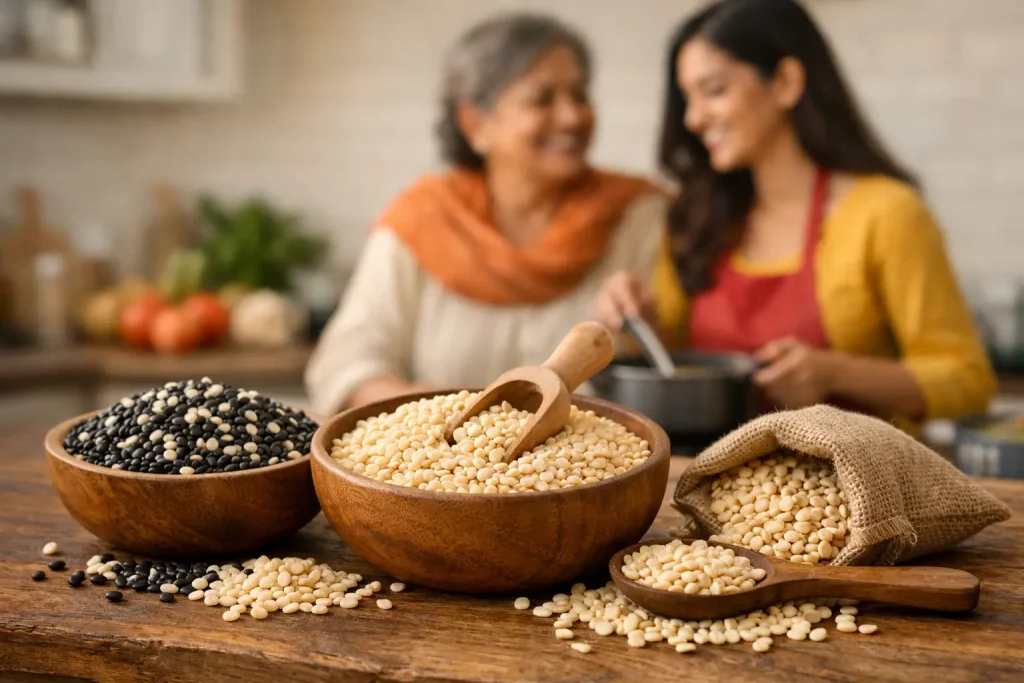
Whole urid dal, also called whole black gram, has the black skin intact. This is the one commonly used for dal makhani and slow-cooked dals where the deeper flavor and creamy texture matter. If you want body, richness, and a more traditional finish, whole urid dal is usually the better choice.
Split urid dal with skin is less common for everyday quick cooking, but some households prefer it for specific regional recipes. It cooks faster than whole urad while still keeping some of that earthy flavor from the skin.
Split and skinned urid dal, often sold as white urad dal or dhuli urad dal, is the go-to option for idli, dosa, and vada batter. Because the skin is removed, it grinds smoother and gives a lighter result. It is also a practical choice for simple dal dishes when you want quicker cooking and a softer texture.
If you are stocking just one packet for general use, think about what you cook most often. A family making batter every week should prioritize skinned urid dal. A household that cooks Punjabi-style dals more often will get better value from whole urad.
This is where how to choose urid dal becomes much easier. Recipes give you clues, and your regular menu should guide your buying.
For idli and dosa, choose clean, skinned whole or split urid dal that looks fresh and fairly uniform. Good urad for batter should grind fluffy and help fermentation. Older stock can still cook, but it may not perform as well for soft idlis or crisp dosas.
For medu vada, quality matters even more. You want urid dal that grinds into a smooth, thick batter with enough lightness for frying. If the dal smells stale or looks overly dry and aged, the batter may feel flat.
For dal makhani, whole urad is the standard choice. Here, the skin is not a drawback – it is part of the character of the dish. The slow cooking breaks it down and gives that signature creamy finish.
For simple home-style dal, split white urid dal is convenient because it cooks faster and has a milder taste. It is a good option for busy weeknight cooking when you want comfort food without a long soak and simmer.
Even if you already know the type you need, appearance tells you a lot about quality. A good packet of urid dal should look clean, dry, and consistent in size. Too much broken material or powder at the bottom can suggest rough handling, older stock, or lower grading.
For whole urad, the black grains should look intact and reasonably even, not faded or patchy. For white urid dal, the grains should look creamy white, not grayish or yellowing. Slight natural variation is normal, but the packet should not look dull or dusty.
Also look for obvious signs of moisture damage. Clumping, fogging inside the pack, or grains sticking together are all reasons to put it back. Dal stores well when handled properly, but once moisture gets in, quality drops quickly.
One common mistake is assuming dal lasts forever in the same condition. It lasts a long time, yes, but performance changes with age. Very old urid dal can take longer to soak, may grind less smoothly, and sometimes gives weaker fermentation results.
If you are buying for idli or dosa batter, fresher stock usually gives more reliable results. That does not mean you need a very new harvest every time, but it helps to buy from a store with good turnover. Products that move regularly are less likely to be sitting on shelves for too long.
Packaging date and best-before date are useful guides. They are not the only indicators, but they do help. If you have two similar options, the one with more shelf life left is often the safer pick for regular household use.
Many experienced shoppers already know this from rice, atta, and spices – consistency matters. With urid dal, trusted brands often give you more uniform grain size, cleaner sorting, and more dependable cooking results. That is especially useful if you make the same staples every week and want fewer surprises.
That said, the most expensive packet is not automatically the best one for every kitchen. Sometimes a mid-priced, reliable brand gives excellent results for daily cooking. The real value is in a product that cooks well, tastes right, and fits your routine without waste.
At a practical level, this is why many families prefer shopping from a local Indian grocery they trust. Stores that focus on authentic pantry staples tend to carry the forms and brands people actually use at home, rather than a one-size-fits-all selection.
It depends on how often you use it. If urid dal is part of your weekly cooking, buying a larger pack can make sense for value. If you use it only occasionally for one or two festival dishes, a smaller pack is the better choice. Bulk buying saves money only when the product stays fresh enough to perform well.
For batter-making households, medium packs are often a smart balance. You get better pricing than very small packs, but you are not holding old stock for too long. For dal makhani lovers who cook it often, larger packs of whole urad can be practical.
Storage matters here too. Once opened, keep urid dal in a clean, airtight container away from heat and moisture. That simple step protects flavor and texture and helps avoid pantry pests.
When shopping in-store, you can inspect the packet more closely for color, cleanliness, and grain quality. That makes it easier if you are particular about batter results or cooking texture.
When shopping online, read the product name carefully. This is where many shoppers order the wrong type by mistake. Whole urad, split urad, and skinned urad may all appear in search results together. Double-check whether the skin is on or off and whether the dal is whole or split before you add it to cart.
If a store clearly labels authentic Indian pantry staples and carries trusted everyday brands, that makes repeat shopping much easier. For busy households, that kind of consistency is worth a lot because it cuts down on trial and error.
If you want the simplest way to decide, think in three steps. First, choose the form based on the dish. Second, check that the dal looks clean and fresh. Third, buy a pack size that matches how quickly your household will use it.
That approach works better than chasing a single “best” urid dal, because the right choice depends on your cooking habits. A packet perfect for dosa batter may not be the one you want for dal makhani, and vice versa.
One Stop Supermarket serves many families who shop this way – not just by price, but by whether a pantry staple is authentic, dependable, and right for the meals they cook every week.
The best urid dal is the one that fits your kitchen, cooks the way you expect, and makes your everyday meals feel easy again.