
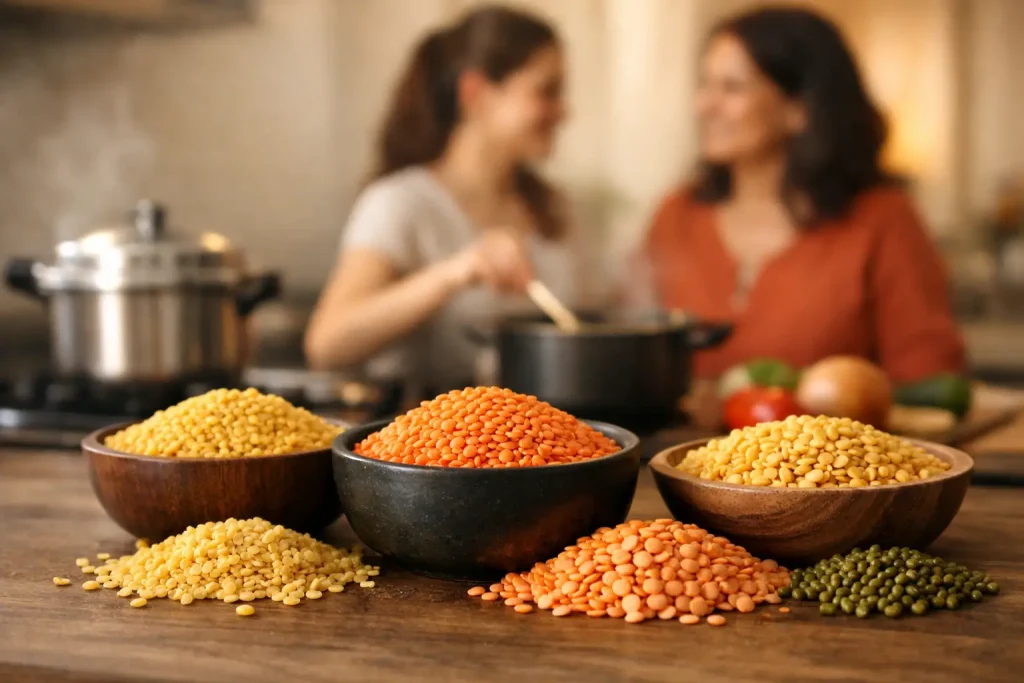
A late dinner does not need to mean reaching for packaged food. If you are wondering which dal cooks the fastest, the most reliable answer is split yellow moong dal, also called dhuli moong dal. It softens quickly, has a mild familiar flavor, and can become a comforting bowl of dal in about 15 to 20 minutes on the stovetop without soaking.
Split red masoor dal is another excellent fast-cooking choice. It often cooks in a similar time and breaks down into a smooth, creamy texture with very little effort. Both are smart pantry staples for busy households that want a warm, homemade Indian meal without a long wait.
Split yellow moong dal is usually the fastest-cooking dal for everyday home cooking. Because the husk has been removed and the lentils are split, water reaches the center quickly. Rinse it well, add water, turmeric if you use it, and cook until soft. It is especially useful for light dal, khichdi-style rice dishes, and simple meals when someone in the family prefers gentle flavors.
Red masoor dal comes very close. It is sold split and without its skin, which is why it cooks quickly and turns soft fast. Its color becomes golden as it cooks, and it makes a naturally thick dal that pairs well with rice, roti, or paratha. If you like a smoother texture, masoor is often the easier choice because it almost melts into the cooking liquid.
The exact winner can change slightly depending on the brand, how long the dal has been stored, and how much water you use. For most kitchens, though, yellow moong and red masoor are the two quick-cook options worth keeping on hand.
Cooking time depends on whether the dal is split, skinned, whole, or soaked. A pressure cooker will reduce these times, but stovetop cooking gives a useful guide for planning dinner.
| Type of dal | Typical stovetop time | Texture and best use | |—|—:|—| | Split yellow moong dal | 15-20 minutes | Soft, mild, light everyday dal | | Split red masoor dal | 15-20 minutes | Creamy, quick weeknight dal | | Split moong with skin | 20-30 minutes | Earthier flavor, slightly more bite | | Toor dal | 30-40 minutes | Classic fuller-bodied dal, often better in a pressure cooker | | Split urad dal | 30-40 minutes | Richer, creamier texture for selected dishes | | Chana dal | 40-50 minutes | Firm, nutty, holds its shape | | Whole dals | 45-90 minutes | Deep flavor, usually need soaking or pressure cooking |
These are practical ranges, not fixed rules. Older packets can take longer to soften, while a fresh, well-sealed packet may cook faster. Hard water can also slow the process. If a dal remains firm after the expected cooking time, add more hot water and keep it simmering rather than rushing to add more seasoning.
Dal has a simple rule: less outer layer means less cooking time. Whole lentils have their skins intact, so water takes longer to penetrate. Split dals have been divided into smaller pieces, and skinned dals have an additional barrier removed.
That is why whole urad, whole masoor, and whole moong are excellent for slow-cooked dishes but are not the first choice when dinner needs to be ready quickly. Chana dal may be split, but it is naturally dense and stays firmer than moong or masoor. It is delicious when you want texture, just not when speed is the priority.
For split yellow moong or red masoor, soaking is optional. A thorough rinse is usually enough. Place one cup of rinsed dal in a pot with around three cups of water. Bring it to a boil, then lower the heat to a steady simmer.
For a thinner, pourable dal, add a little more water as it cooks. For a thicker bowl, start with less and stir occasionally so it does not catch at the bottom. Yellow moong may need a few extra minutes to become completely soft, while masoor often thickens quickly and benefits from an extra splash of hot water near the end.
Salt is best added after the dal has started to soften. This is not a strict rule, but it can help you judge the final texture more easily. Add your preferred spices, a simple tadka, or a ready-made seasoning blend once the dal is cooked to your liking. Even a basic finish of cumin, garlic, chili, and ghee can turn a fast pantry meal into something everyone looks forward to.
A pressure cooker is useful when you are cooking toor dal, chana dal, or whole dals, but it is not always necessary for moong and masoor. For such quick dals, the time saved may be small once the cooker comes to pressure and releases it.
For yellow moong or red masoor, a short pressure cook is enough. In an electric pressure cooker, try about 4 to 6 minutes on high pressure, then allow a brief natural release. If the dal is turning too thick, stir in hot water after opening the lid. For toor dal, allow more time, commonly around 10 to 15 minutes under pressure depending on the desired softness.
The advantage of a pressure cooker is consistency, especially when preparing larger portions for the family. The advantage of the stovetop is control. You can see exactly when the dal has reached the texture you want.
Choose yellow moong when you want a light, clean-tasting dal that does not feel heavy. It is a dependable choice for simple rice meals, soft khichdi-style dishes, or a gentle dinner after a busy day. Its mild flavor also carries a tempering well without competing with it.
Choose red masoor when you want a more creamy, satisfying bowl in the same short cooking window. It is ideal for a quick dal with roti or for a thicker meal that can be scooped easily. Since it breaks down more than moong, it is less suitable if you prefer distinct lentil grains.
Choose toor dal when you have a little more time or plan to use a pressure cooker. Its comforting, traditional flavor is worth the wait, and it remains a household favorite for everyday Indian meals. Chana dal is the choice for a nuttier bite, not for the fastest cooking time.
A useful household strategy is to keep more than one kind of dal. Use toor, chana, and whole dals for planned meals, then keep yellow moong and red masoor ready for those evenings when the pantry needs to work harder for you.
Start with a fresh packet from a trusted grocery store. Dal that has sat open for a long time can dry out and take longer to soften. Store it in an airtight container away from heat and moisture, and use older stock first.
Rinsing also matters. Wash the dal two or three times until the water is less cloudy. This removes surface starch and any packing dust, helping you get a cleaner-tasting finished dish. Use hot water if you need to top up the pot during cooking, because cold water can slow the simmer.
Avoid adding acidic ingredients at the beginning. Tamarind, lemon juice, and tomato-based ingredients can make some lentils take longer to soften. Cook the dal until tender first, then add tangy flavors near the end. This small change makes a noticeable difference with toor and chana dal, and it keeps quick meals on schedule.
For reliable everyday staples, One Stop Supermarket makes it easy to stock authentic dal varieties for both planned family meals and fast weeknight cooking. Keep yellow moong and red masoor in your pantry, and a comforting homemade dal is never far away.